ENZO-TS

C++ trading-systems case study

A complete algorithmic trading platform, from market data to live execution.

ENZO-TS is a multi-process C++20 platform for algorithmic trading research and live operation. It spans exchange adapters, historical-data ingestion, exchange-aware simulation, model evaluation, signal distribution, portfolio allocation, execution, and risk controls.

01 Architecture

Signal to execution

Signal generation, distribution, orchestration and execution each run as their own process. Separating them keeps account credentials inside the execution clients, lets one market's model crash without taking the portfolio down with it, and allows a single set of signals to drive more than one account.

Market data

Streams and cached candles

TSP

Signal generators

One process per market

TSM

Network hub

Distributes signals

TSL

Launcher

Ranks candidates, allocates

TSC

Execution clients

Orders, state, reconciliation

Exchange APIs

One client per account

Shared libraries exchange access · simulation · backtesting · models · indicators · reporting · configuration · networking · interfaces

02 Exchange and execution

Order lifecycle against live venue APIs

The exchange layer is the part that has to be right every time. It covers Binance and Bybit over both REST and WebSocket, on public market streams and private account streams.

Execution client

Venue API

Places an order, tagged with a client order ID

Accepts it and returns an exchange order ID

Tracks the order as working

Streams status changes and fills

Cancels on a stop or a drift check

Confirms the cancellation

Reconciles its own state after a restart

Reports open orders and positions

Both identifiers persist so an order stays traceable across a restart or a dropped connection

Connectivity
REST and WebSocket adapters per venue, carrying public market data on one side and private account events on the other.
Order lifecycle
Placement, cancellation and status tracking, with persistent exchange and client order identifiers so an order can be traced back to the signal that produced it.
Reconciliation
Local order state is checked against what the venue reports, so a restart or a dropped connection does not leave the system guessing about a position.
Venue constraints
Server-clock synchronization against venue time, and explicit rate-limit and HTTP 429 handling rather than retry-and-hope.
Historical data
Candle ingestion with local caching, so research and live processes read the same market history without refetching it from the venue on every run.
Portability
A Phemex adapter and continuing work to decouple the system from the shape of any one venue's API.

03 Simulation and research

Historical evaluation that models the venue

A backtest is only as good as its fills. The simulator models exchange order behaviour and applies commissions and trading costs, rather than assuming an ideal fill at the closing price.

Data and fills
Sub-minute historical data through an exchange-aware order simulator, with positions and trades persisted for later inspection.
Portfolio simulation
Runs span multiple markets at once, so allocation behaviour can be studied rather than inferred from single-market results.
Reporting
P&L, alpha, win rate and monthly statistics, alongside Sharpe, Sortino and maximum drawdown, so a run is judged on more than one number.
Models
Custom indicators and a strategy framework, with several model families explored side by side rather than one line of research pursued alone.
Validation
Out-of-sample practice and leakage controls, treated as first-class concerns. Most of the research effort goes into not fooling yourself.

04 Portfolio, risk, and operations

Controls around the live path

The orchestrator evaluates persisted signal statistics, ranks allocation candidates, and applies allocation rules before instructing the execution clients.

  1. All markets with signals

    Arriving from the hub

  2. Markets permitted to trade

    Market gating, active-market limits

  3. Ranked candidates

    Persisted signal statistics

  4. Allocated weights

    Sizing mode, leverage, per-market switches

  5. Instructions to account clients

    Sent over IPC

Allocation
Position sizing with equal, linear, fixed and manual modes, plus configurable leverage and per-market trading switches.
Market gating
Active-market limits decide which markets are permitted to trade at all, before weight is assigned to any of them.
Trade controls
Stop-loss with a fallback stop path, entry-drift tolerance to skip fills that have moved too far, and cooldown and retry logic.
Supervision
Process groups are supervised and restarted, communicating over TCP/IP between hosts and IPC between local processes.
State and diagnostics
State persists across restarts, with logs and runtime diagnostics surfaced in the operator interfaces.

05 Stack

What it is built on

A single C++ codebase carries the runtime, the research tooling and the interfaces, so a model can be evaluated and then run without being reimplemented.

Runtime
C++20 across the process types and the shared libraries they are built on, with multi-threaded work for research and evaluation loads.
Machine learning
LibTorch for training and evaluating models inside the C++ runtime, with PyTorch alongside it for research work.
Model search
Genetic algorithms and neuroevolution beside conventional backpropagation training, run over populations of candidate networks.
Networking
TCP/IP between hosts and IPC between local processes, with the hub distributing signals to whichever clients subscribe.
Storage
A local historical candle store with caching, alongside persisted positions, trades and runtime state.
Build targets
Windows, Linux, macOS and Raspberry Pi.

06 Interfaces

Operator and research tooling

Built alongside the platform, and used to configure runs and study what came out of them.

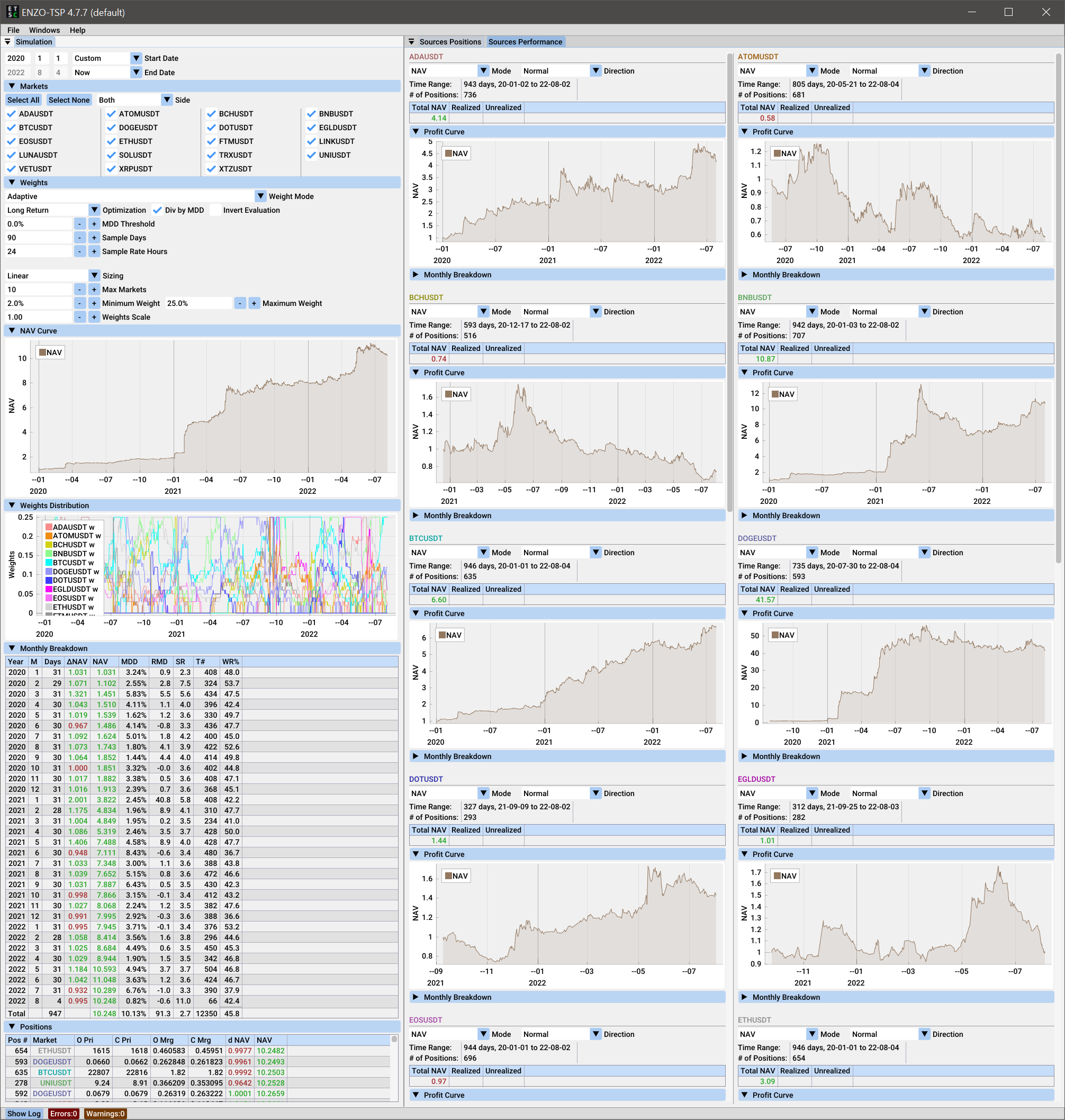
Portfolio simulator showing market selection, weighting and sizing controls, and per-market result panels
Portfolio simulator. Market selection, weight mode, drawdown threshold and sizing rules on the left; per-market simulation panels on the right.

Contact

Get in touch

Open to conversations about trading infrastructure, systems and performance engineering, and C++ work.